Randolph "Mick" Stow
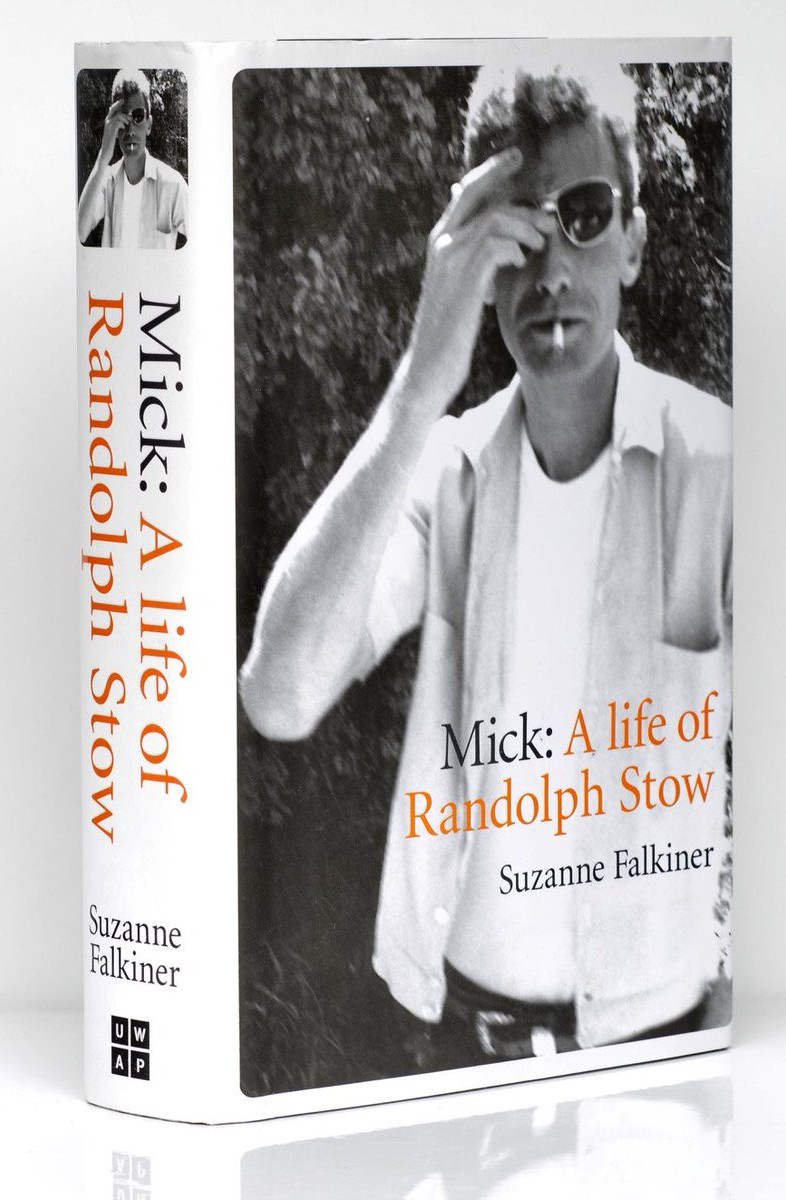
An Australian writer I've been interested in ever since my first visit to Sydney in 2015, though one not seemingly as well known as some, is Randolph Stow. I'm pleased to have bought his biography in a shop only half a mile away from the birthplace of Barry Humphries, in the Melbourne suburb of Camberwell.
April 2019
Julian Randolph Stow (28 November 1935 – 29 May 2010)
Born in Geraldton, Western Australia, Randolph Stow was the son of Mary Campbell Stow née Sewell and Cedric Ernest Stow, a lawyer.
Stow attended the University of Western Australia and the University of Sydney. During his undergraduate years in Western Australia he wrote two novels and a collection of poetry, which were published in London by Macdonald & Co. He taught English literature at the University of Adelaide, the University of Western Australia and the University of Leeds.
Career
He also worked on an Aboriginal mission in the Kimberley, which he used as background for his third novel To the Islands. Stow further worked as an assistant to an anthropologist, Charles Julius, and as a cadet patrol officer in the Trobriand Islands off the east coast of New Guinea. In the Trobriands he suffered a mental and physical breakdown that led to his repatriation to Australia. Twenty years later, he used these last experiences in his novel Visitants.
Stow first visited England in 1960 and lived there for a few years, although he returned several times to Australia. Tourmaline, his fourth novel, was completed in 1962 while he taught in Leeds. In 1964 and 1965 he travelled in North America on a Harkness Fellowship, including a sojourn in Aztec, New Mexico, during which he wrote one of his best known novels, The Merry-Go-Round in the Sea. While living in Perth (WA) in 1966 he wrote his popular children's book Midnite.
From 1969 to 1981 he lived at East Bergholt in Suffolk in England, his ancestral county, and he used traditional tales from that area to inform his novel The Girl Green as Elderflower. The last decades of his life he spent in nearby Harwich, the setting for his final novel The Suburbs of Hell. He last visited Australia in 1974.
Stow died in England on 29 May 2010.
The Girl Green as Elderflower (1980)
This novel is often considered to be closely linked to Stow's life. After dealing with a bout of malaria in Papua New Guinea, he moved to East Bergholt in Suffolk in England from 1969 to 1981, his ancestral county, and he used traditional tales from that area, many of which he translated from Latin himself, to inform his novel. The regional stories Stow used for the novel were collected by William of Newburgh, Gervase of Tilbury, Gerald the Welshman, Ralph Coggeshall, Roger Howden, and Walter Map. Many of the characters in the novel are based on Stow's friends. He conducted research in advance of publication for several years. In 1978, he and John Constable's great-great-grandson were in a serious car accident, which finally spurred Stow to begin writing the novel. On New Year's Day 1979, he began writing and finished thirty-two days later.
Awards and legacy
His novel To the Islands won the Miles Franklin Award for 1958. He was awarded the Patrick White Award in 1979. As well as producing fiction, poetry, and numerous book reviews for The Times Literary Supplement, he also wrote libretti for musical theatre works by Peter Maxwell Davies.
Randolph Stow's later years were spent living in Harwich, Essex (he had English connections). When asked about the location of his house, he said it was it within walking distance of ten pubs, and crawling distance of five!